MedSeg Liver Segments
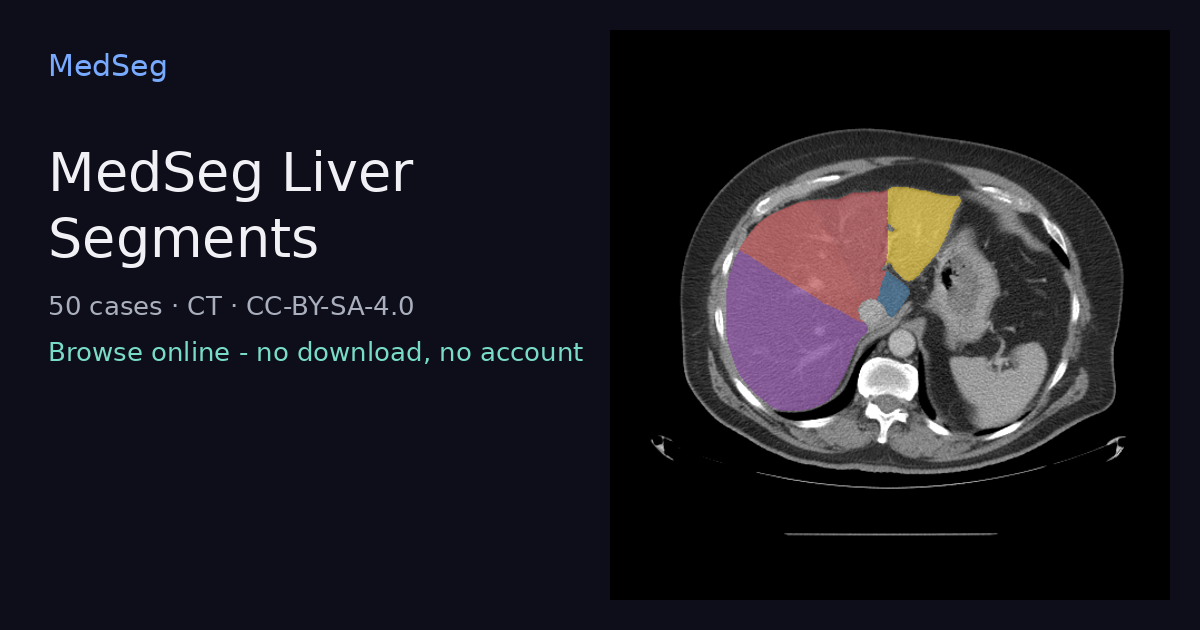
Liver Couinaud segments (1-8) labelled on 50 abdominal CT cases.
The sample cases below open read-only in the MedSeg editor - no account needed. Open the full dataset to copy all 50 cases into your workspace, run AI models, and segment.


About this dataset
The liver divided into its Couinaud anatomical segments on 50 abdominal CT cases, segmented by the MedSeg team.
Source images derived from the Medical Segmentation Decathlon (Task03 Liver), released CC-BY-SA-4.0 - attribute the Medical Segmentation Decathlon (medicaldecathlon.com) and keep share-alike.
| Fact | Value |
|---|---|
| Cases | 50 |
| Series | 50 |
| Size | 0.6 GB |
| Modality | CT |
| Reference masks | Yes |
| License | CC-BY-SA-4.0 |
| Publisher | MedSeg |
| Version | - |
| DOI | 10.6084/m9.figshare.13643252 |
What you can do with it in MedSeg
Copied cases behave like normal project series - the public image bytes are linked, not duplicated, so copies are instant and take no extra storage.
- Copy cases into a project.
Filter, multi-select, copy - reference masks come along if you want them. - Run AI segmentation.
TotalSegmentator, MRSegmentator, nnInteractive 3D clicks/scribbles, or text-prompted VoxTell. - Edit and measure.
Brush, lasso, fill, oblique planes, volumes in ml - in the browser. - Train your own nnU-Net.
Correct masks on a handful of cases and train a custom model on hosted GPUs.
License: CC-BY-SA-4.0
Open data still carries obligations - attribution at minimum. Check the license terms and the source publication before publishing work built on this dataset. MedSeg is a research tool, not a medical device.
More public datasets

MedSeg Lateral Ventricles (MRI)
MR 50 cases

MedSeg Inferior Vena Cava
CT 20 cases

MedSeg COVID-19 CT
CT 10 cases

TotalSegmentator (v2)
CT 1,228 cases

AMOS22 - Abdominal Multi-Organ
CT, MR 600 cases

ReMIND - Brain tumor multi-modal MR (raw, with iUS)
MR, US 990 cases

LIDC-IDRI - Lung CT with nodule pathology
CT 1,010 cases

BHSD - Brain CT Intracranial Hemorrhage
CT 2,174 cases

HCC-TACE-Seg - Liver cancer multi-phase CT
CT 628 cases

TotalSegmentator - Pleural + Pericardial Effusion
CT 600 cases

Head CTA Aneurysm - DICOM with STL annotations
CT 172 cases

TotalSegmentator - Liver Lesions (CT)
CT 842 cases

Vestibular-Schwannoma-MC-RC - routine multi-center MR
MR 487 cases

TotalSegmentator - Liver Lesions (mixed MR + CT)
CT, MR 750 cases

Colorectal-Liver-Metastases - CT with tumor masks
CT 197 cases

TotalSegmentator - Liver Couinaud Segments (MR)
MR 59 cases

Prostate158 - 3T prostate MRI
MR 473 cases

Medical Decathlon - PROSTATE
ADC, T2 64 cases

MedSeg Anatomy Atlas
CT,MR 10 cases