Repeatable target
If the same anatomy or lesion appears across many cases, corrected examples can become a project-specific model.
MedSeg lets you move from annotation to model training inside the same project. Mark masks as training sources, choose 2D or 3D nnU-Net, optionally transfer from another project model, and queue hosted GPU training.
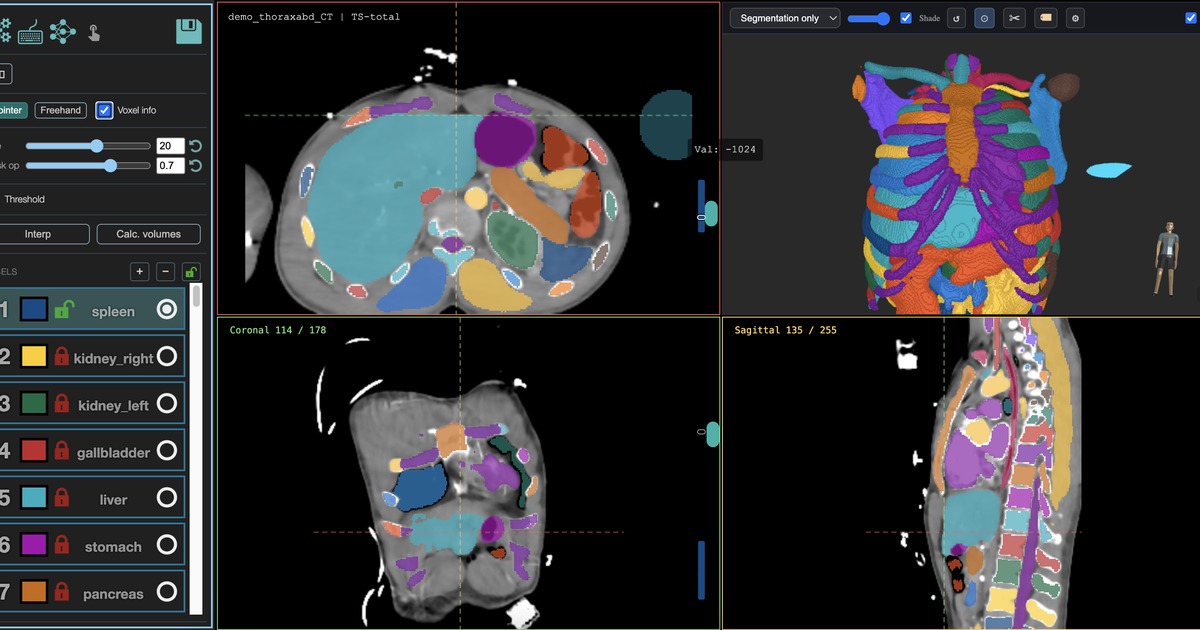
Promptable tools are excellent for first masks. A trained model is better when the same target must be segmented repeatedly.
If the same anatomy or lesion appears across many cases, corrected examples can become a project-specific model.
Train on your label definition instead of hoping a public model matches your cohort and annotation style.
Use 3D training for volumetric CT/MRI and 2D training for single-slice or high-resolution 2D workflows.
Open datasets are useful for practicing the workflow before using your own private cohort.
Large labelled CT dataset for whole-body anatomy experiments.
Abdominal CT/MR organs for multi-organ model practice.
LIDC-IDRI, BHSD, ReMIND, HCC-TACE-Seg, and other catalog entries for lesion-oriented work.
Do not judge a model by training loss alone. Keep validation or held-out cases, inspect failures visually, and document the cohort. Custom models trained in MedSeg are research tools unless separately validated and regulated for clinical use.